
30 September 2026 · James Wehner · 5 min read
AI is running on subsidy. Are you prepared for when the bill arrives?
On 28 September 2026, SpaceX's Starship reached orbit for the first time. On its fourteenth test flight, it deployed 26 of the new Starlink V3 satellites, the first operational payload it has ever carried.
The numbers are what matter. Each V3 satellite is designed to add up to 1 terabit per second of capacity, so this single flight added as much as 26 Tbps to the Starlink network. SpaceX said that, in bandwidth terms, the flight was equivalent to 20 Falcon 9 launches.
Starlink is only the first cargo. SpaceX, which absorbed Elon Musk's AI company xAI in February, has asked regulators for permission to launch up to a million satellites that work as data centres in orbit, powered by near-constant sunlight. The first prototypes are due next year. Starship is the lorry that makes that plan possible, and this flight was its first time out of the yard.
You don't have to believe every date on Musk's roadmap to see where this is heading. The companies that own the cheapest compute will end up setting the price of AI.
Back on Earth, someone else is paying
Most businesses buying AI tools today are paying far less than those tools cost to provide.
Anthropic's draft IPO prospectus, reported by Reuters on 28 September, shows revenue of about $4.6 billion in 2025 and an operating loss of about $8 billion. (The headline net loss of $42 billion is mostly a non-cash accounting charge, so the operating figure is the honest one.) It also lists around $518 billion of future commitments to cloud, compute and infrastructure.
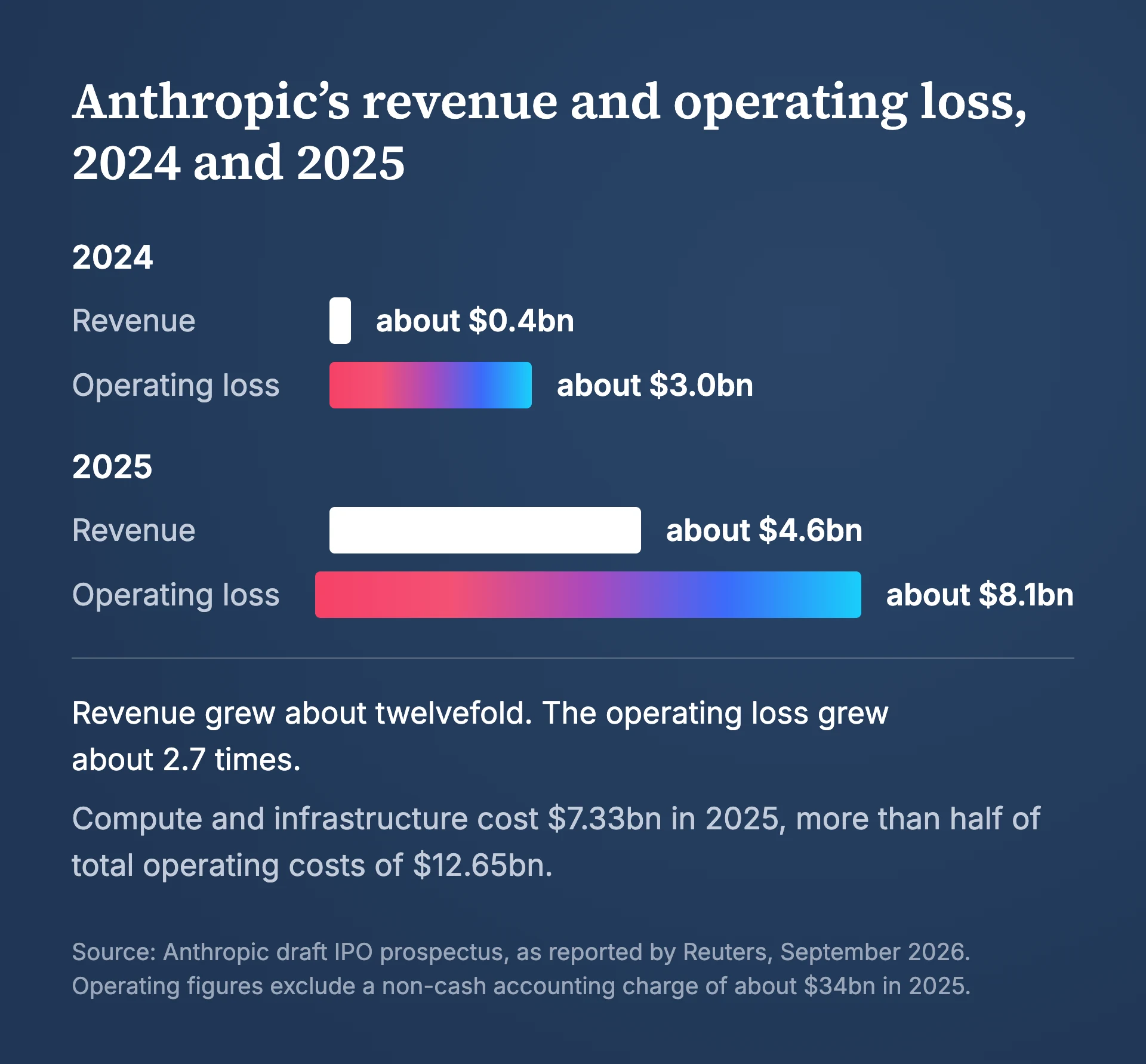
That isn't a criticism. Building the future is expensive, and investors are choosing to fund it. But it does mean the price you pay for AI today is partly set by investors, not by what the service costs to provide. Every business that has built its workflows, products and headcount plans around today's prices is quietly relying on that subsidy continuing.
At some point the market will want a return. When it does, prices can move quickly.
The twist: the rocket company is already the landlord
It's tempting to imagine a simple fight: SpaceX's own AI undercuts the Earth-bound labs from orbit. The reality is more interesting.
In May, Anthropic agreed to take all of the compute at SpaceX's Colossus 1 data centre in Memphis, the cluster originally built to train Grok. It also said it wanted to explore orbital compute with SpaceX. So the company planning data centres in space is already renting capacity to one of the labs it competes with.
The lesson is that whoever owns the infrastructure has leverage over everyone who builds on it, competitor or customer. The AI market is starting to look less like a race between models and more like a race to own the power stations.
We've seen this film before
Anyone who ran technology before the cloud will recognise the shape of this.
Twenty years ago, a large business might run its core systems on Oracle databases, on expensive servers it had bought outright. The licences were costly, but the real cost was leaving. Every application, report and integration assumed Oracle underneath. When cheaper options appeared, many companies worked out that migrating would cost more than simply paying the next bill, so they paid it.
AI is building the same kind of dependency, only faster. Prompts are tuned to one model's quirks, agents are wired into one vendor's tools, teams are trained on one ecosystem, and data sits where it's convenient rather than where it's portable. None of it feels like lock-in while prices are low, but it will when they rise.
To be fair to the other side of the argument, AI prices have mostly gone down, not up. Capability that cost a fortune two years ago is cheap today, and competition, including from orbit, may keep pushing that way. Nobody knows for certain which direction prices will go. But that's exactly the point: if you can't predict the price, the thing you can control is how hard it would be to switch.
Build as if the subsidy will end
I've spent a good part of my career getting businesses out of this kind of dependency. At Osprey and at Believ, both growing EV charging networks, the core platform ran on third-party software that was expensive, restrictive and hard to escape. In both cases the answer was to own the parts that matter, and to rent everything else on terms we could walk away from.
The same thinking applies to AI:
- Keep a layer between your business and the model. Your products and workflows should talk to your own interface, not straight to one vendor, so a model can be swapped without a rebuild.
- Own your data, prompts and tests. The evaluations that tell you whether a new model is good enough are worth more than any single model.
- Know your unit costs. Understand what each AI-powered workflow costs to run, and what it would cost at two or three times today's prices.
- Keep the skills in-house. A small team that understands how your AI works under the hood is what makes switching possible when the moment comes.
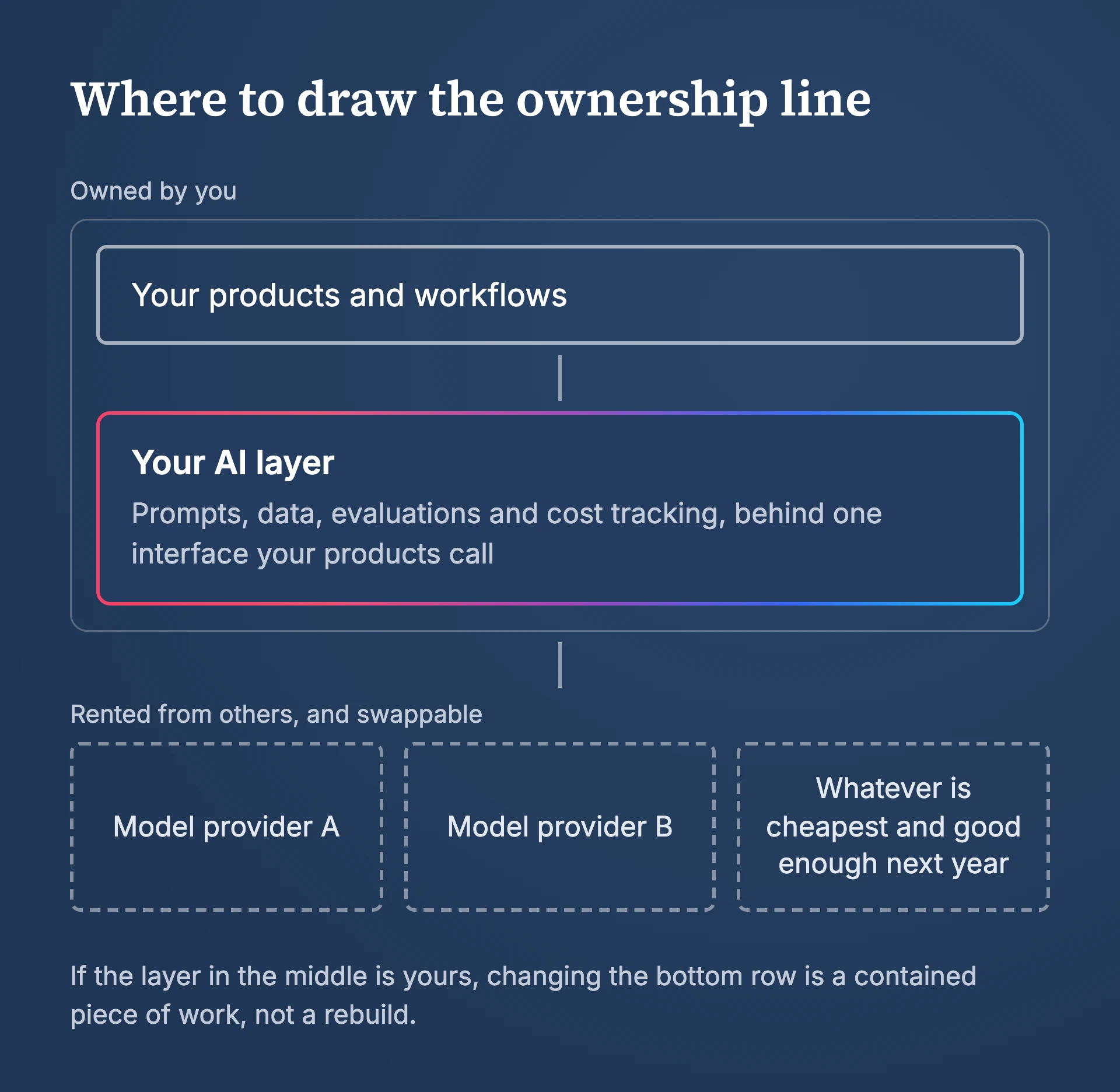
None of this means slowing down. Use the subsidised tools while they're cheap. Just don't build your business in a way that only works while they stay cheap.
AI has made building fast. It hasn't made building right. I've spent more than twenty years learning how to build lean teams that deliver products, features and capabilities that add real value, on platforms the business owns. Now I help companies do that with AI, moving faster without handing the keys to someone else. If you'd rather not find out what the bill looks like the hard way, let's talk.