
6 October 2026 · James Wehner · 7 min read
Programmes are won before the board meets
The board approves a programme. The markets decide whether it happens.
In any business where the units can say no, adoption is, in my view, the real deliverable, and it's settled long before the paper reaches the board. By the time it's tabled, the people it affects have already formed a view, and the board hears it in the questions. A confident presentation doesn't change that.
I learned this at Avon, where I led digital and technology across 37 markets.
What was at stake
The markets were semi-autonomous, each with its own customers, regulation, inherited technology, and local commission, incentive and promotion models. The estate had fragmented because it had been delivered market by market, on demand. Our working assessment counted 130 unique combinations of 17 channel code bases and 15 supporting systems across six customer and representative-facing digital channels, and our planning estimates suggested roughly three quarters of our resource went on supporting local variations rather than building core capability.
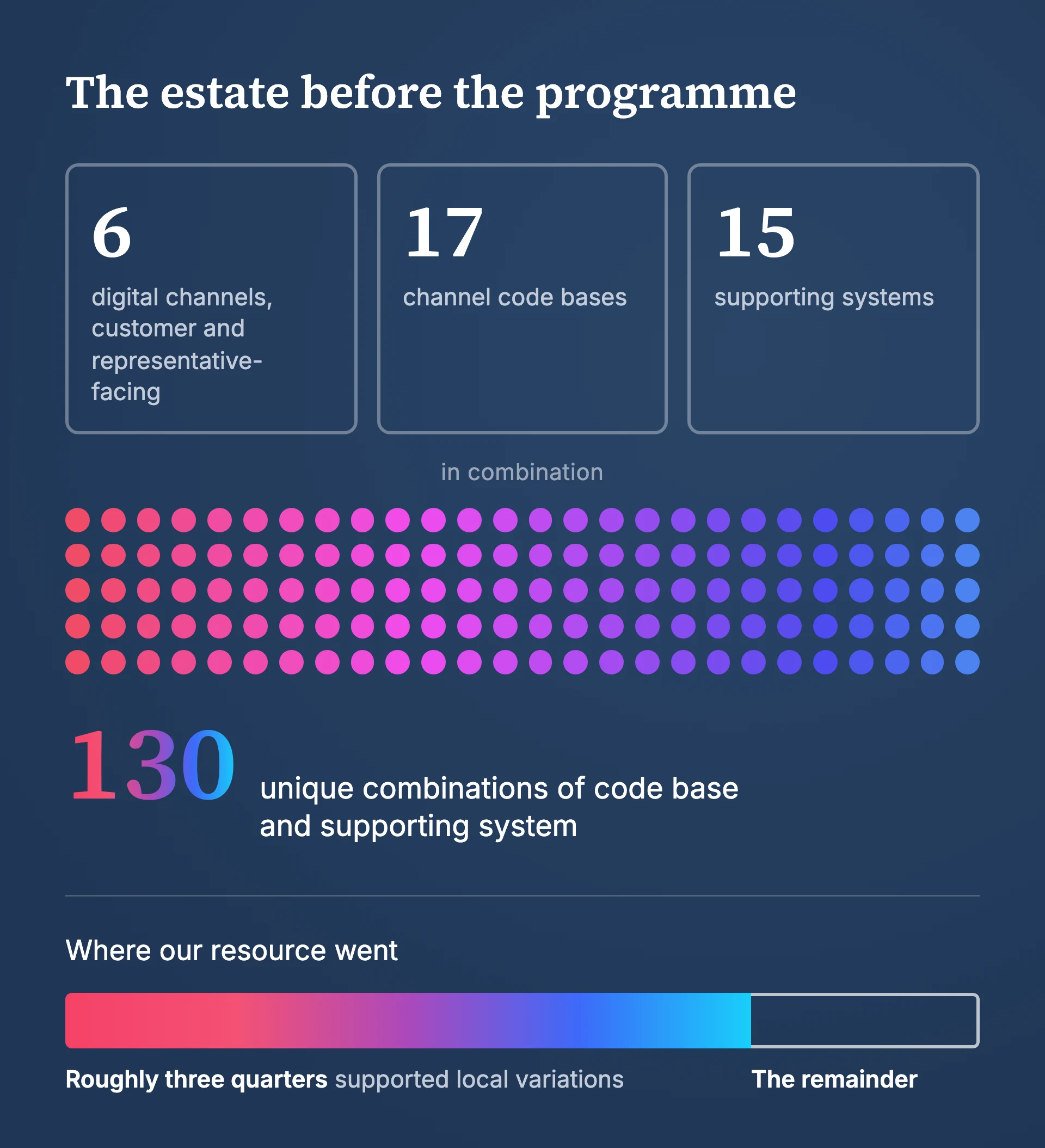
Nobody had done anything wrong. Local leaders were protecting real businesses, and the tools they had built or inherited were part of how they ran them. A shared foundation for commerce, CRM and customer-facing capability would put more of our effort into better experiences, faster delivery and reusable capability. But a central programme arrives as a cost and a risk to a local number, and those markets couldn't simply be told to adopt a global model.
I set the strategy to consolidate onto that shared foundation and redesigned the operating model and sourcing. Approximately $13m of operating cost came out within six months of the new operating model, and that came from the operating-model and sourcing changes, not from trust alone. Trust wasn't the source of the saving. It was what let us build the shared model with the markets rather than around them.
The detail stays private, so here are two small examples
I can't take you through the detail of a programme like this, and you wouldn't expect me to. The pattern shows up in small, ordinary decisions, so here are two, kept deliberately simple.
In Poland, feedback on a proposed four-step sign-up process for new representatives led us to revisit the scope of the New Rep Journey. Nothing dramatic happened. The market knew its representatives, and that knowledge changed a decision that was ours to make. People gain confidence when what they know shapes the decisions that affect them, and they stop offering it when it doesn't.
The second was about data. We needed measures to understand and incentivise adoption of Avon ON, the representative app, and the first request specified login events. The underlying need was to understand usage, which is broader than logging in. Differences between reports helped show that the request and the requirement weren't the same thing. So we revised the measurement approach, involved the business in defining the tests and shared the evidence in a form the markets could follow. Confidence in the information was restored.
Neither example is large. Both are the kind of thing that decides whether a market trusts the centre: whether it's listened to, and whether it can follow and check what it's being told.
The order I hold a programme to
My priorities, in this order, are to build trust, understand what people need, connect those needs to a shared strategy, then deliver. It's an order of priority, not a sequence you finish one step at a time. Listening carried on through delivery.
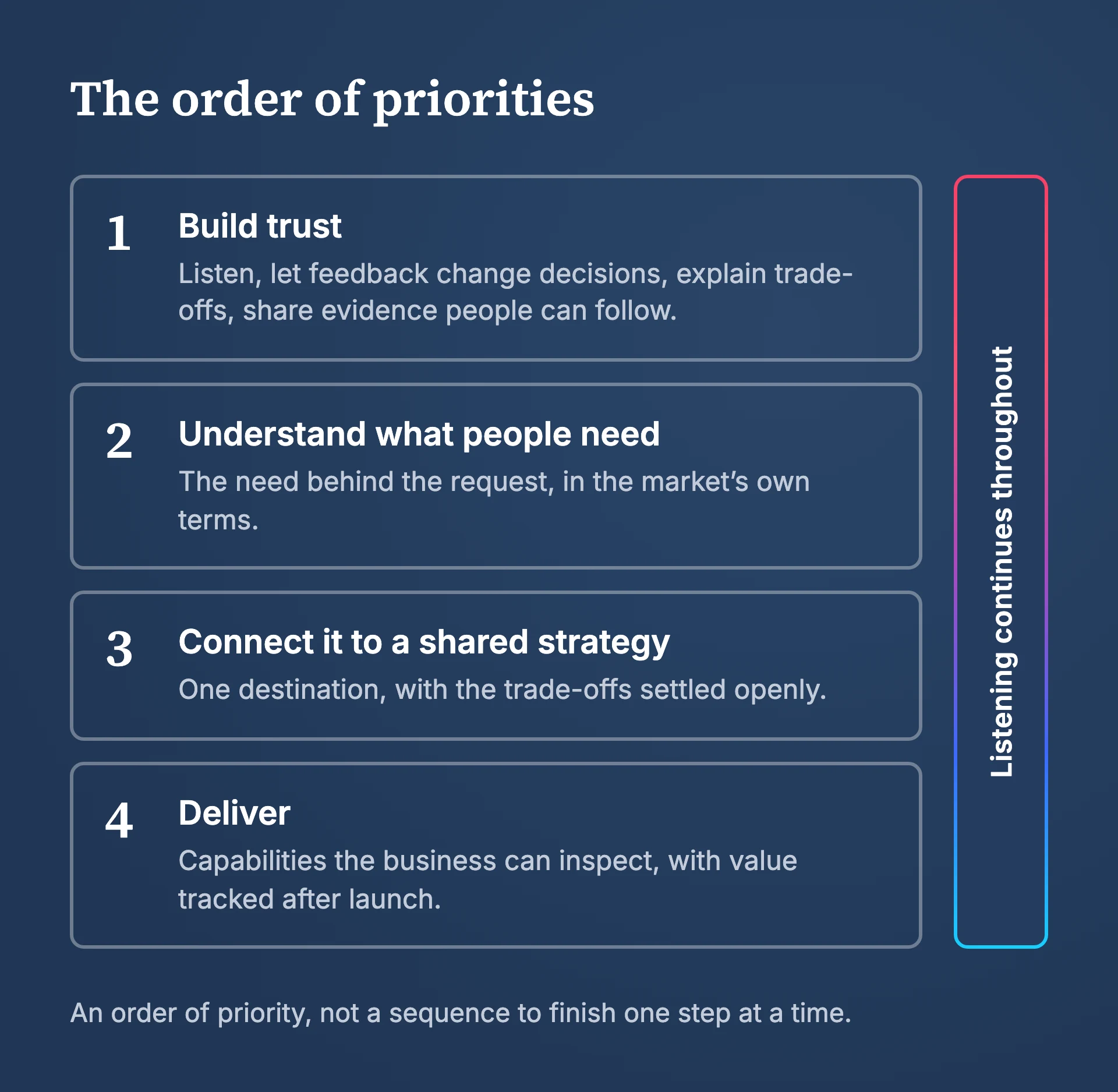
Trust comes from listening, from letting feedback influence decisions, from explaining trade-offs and from giving people evidence they can understand. The strategy then has to connect those local needs to one destination, and be open about where it can't meet them. We worked through local needs against a standard global proposition, including the relationship between direct online and representative channels. Where a market's preference couldn't be met, we explained why. Most of what each market needed was in the shared model, and the rest was settled openly.
Two decisions that make it real
Principles are cheap. Two decisions turned this one into a plan.
The first was to let adoption set the pace. We made deployment depend explicitly on each market's ability to adopt the common template. Choosing where to start meant weighing business readiness and buy-in, fit with the proposed technology, local complexity, access to expertise, alignment with other business priorities, and the commercial and financial opportunity. A technically ready platform was one component of a successful deployment, not the whole of it.
The second was to define done as value reaching end users. We focused on end-to-end capabilities that business users could meaningfully review and respond to, prioritised by commercial benefit, with clear accountability and benefits tracked after launch. So "done" meant something the business had agreed.
What this means for a board
My experience is that the better question for a board isn't whether a programme will deliver. It's whether the people who carry the consequences are behind it, because delivery only earns credit where there's trust. The same milestone is read as progress by a market that trusts the centre and as imposition by one that doesn't.
Watch for silence. A market that agrees with everything in the steering committee and then works round the result in practice hasn't been persuaded. It's been outranked. Objection is useful information, and agreement that costs nothing tells you very little.
A programme that the people it affects have helped to shape, challenged and agreed is a different proposition from one they've merely been told about. That's visible before the paper is written, if you know where to look.
The fair objection is that this takes time, and that asking every market for agreement hands each of them a veto. Listening isn't the same as agreeing. Where a market's preference couldn't be met, we said so and explained why, and the programme kept one destination. A market that has been heard can accept a no from the centre far more readily than one that hasn't.
Three questions before you approve
- Who is most impacted by this change, and can they say in their own words why it's needed?
- What did they ask for that the programme doesn't give them, and how was that settled?
- Can the sponsors point to stakeholder feedback that changed the plan?
The last one tells you most. A plan that has met real stakeholders will have changed in ways its sponsors can name. If nothing has changed, it's worth asking what the consultation was able to influence.
Winning that agreement is the first job of any mandate I take on. I've spent more than twenty years learning how to build lean teams that deliver products, features and capabilities that add real value. If you're about to put a programme in front of your board, let's talk.